Mac Os Photos Library Show Original Location Of Photo
This is a built-in repair tool, comes with macOS and it is pretty easy to use.Step 1: Press and hold the “Option” and “Command” keys while photos are opened on your Mac.Step 2: Then, a dialog box will appear, click on “Repair” to proceed.You will be asked to provide a password for your user account. Solution 1: Use Mac Built-in Photos Library Repair ToolIf Mac photos the library could not be opened or it is showing unexpected errors, then Photos Library Repair Tool is one of the best ways to fix it. Mac os unable to load dynamic library gearman.so. The tool will analyze the library database at the beginning.
The Photos app in macOS Catalina underwent a major upgrade, bringing many iOS 13 Photos features to the Mac OS. And while Photos retains much of the same user interface as recent versions, the entire app feels snappier, while supporting many new features. Photos expects you to export unmodified originals as copies, to preserve the integrity of the internal file management and for collection protection in the same way a database works – it's central to keeping the iCloud storage of your photo collection synced, stable, and functional.
(iPhoto had a 'Show in Finder' option that showed you the original photo on disk - this option is not present in Photos. My guess is it was removed because if those files were within the iPhoto library bundle, moving or renaming it would cause problems with iPhoto displaying it.). Mar 18, 2020 Your Photos library holds all your photos, albums, slideshows, and print projects. If your library is large, and you want to free up storage space on your Mac, turn on iCloud Photo Library and use Optimize Mac Storage, or move your library to an external drive.
Your Photos library holds all your photos, albums, slideshows and print projects. If your library is large, and you want to free up storage space on your Mac, turn on iCloud Library and use Optimise Mac Storage, or move your photo library to an external drive.
Before you start, make sure that you back up your library.
Prepare your drive
You can store your library on an external storage device, such as a USB or Thunderbolt drive formatted as APFS or Mac OS Extended (Journaled).1 Find out how to check the format of your external storage device.
To prevent data loss, Apple doesn't recommend storing photo libraries on external storage devices like SD cards and USB flash drives, or drives that are shared on a network.
Move your Photos library to an external storage device
- Quit Photos.
- In the Finder, go to the external drive where you want to store your library.
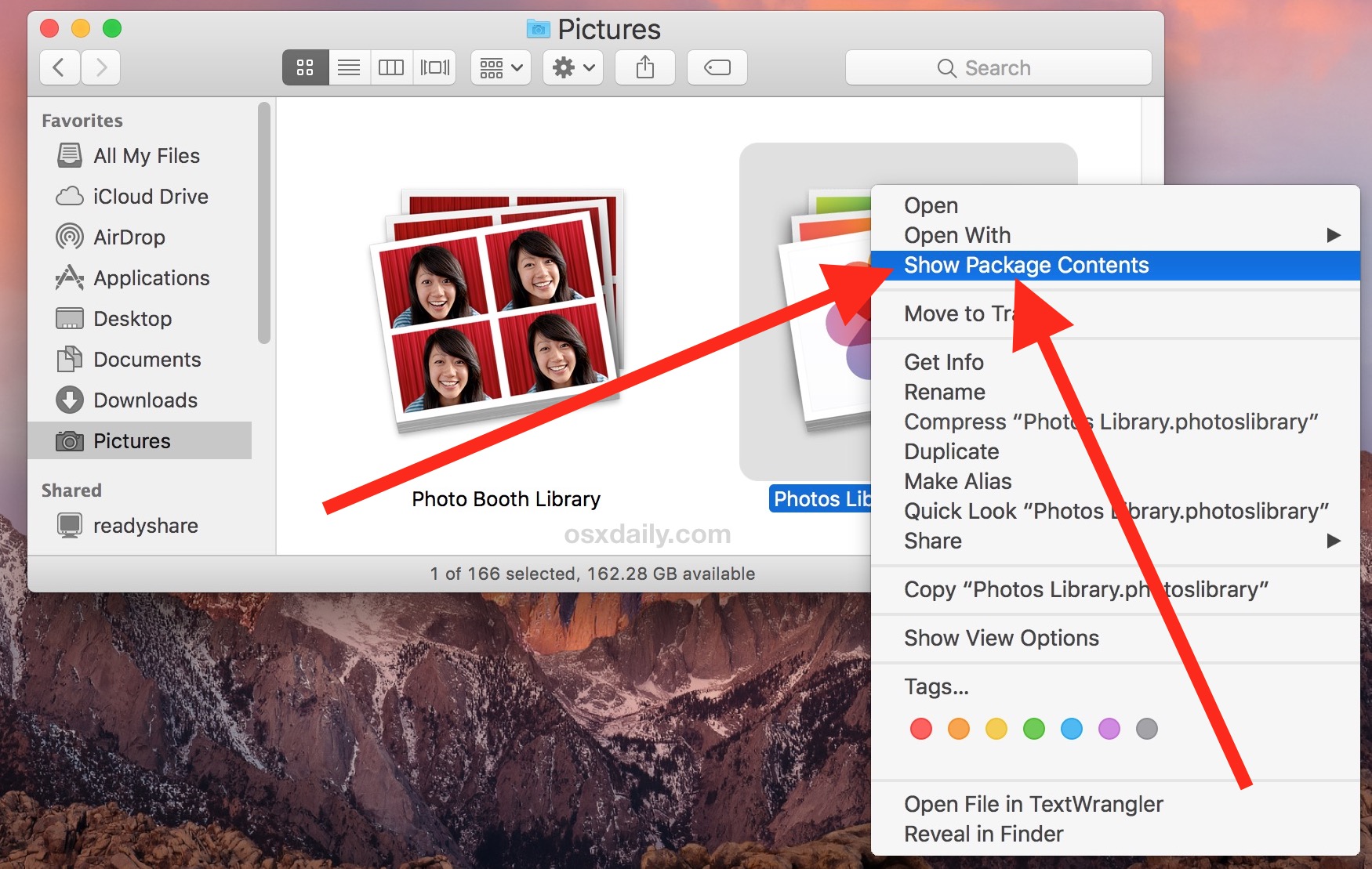
- In another Finder window, find your library. The default location is Users > [username] > Pictures, and it's named Photos Library.
- Drag your library to its new location on the external drive. If you see an error, select your external drive's icon in the Finder, then choose File > Get Info. If the information under Sharing & Permissions isn't visible, click , then make sure that the 'Ignore ownership on this volume' checkbox is selected. If it's not selected, click to unlock it, enter an administrator name and password, then select the checkbox.2
- After the move is finished, double-click Photos Library in its new location to open it.
- If you use iCloud Photo Library, designate this library as the System Photo Library.
Delete original library to save space
After you open your library from its new location and make sure that it works as expected, you can delete the library from its original location.

In a Finder window, go back to your Pictures folder (or whichever folder you copied your library from) and move Photos Library to the trash. Then choose Finder > Empty Trash to delete the library and reclaim disc space.
Open another Photos library
If you have multiple libraries, you can open a different one like this:
Change Photos Library Location Mac
- Quit Photos.
- Press and hold the Option key while you open Photos.
- Select the library that you want to open, then click Choose Library.
Photos uses this library until you open a different one.
Learn more
If you have a permissions issue with your library, you might be able to resolve the issue by using the Photos library repair tool.
Find Photo Library On Mac
1. You can't move your library to a disc that's used for Time Machine backups.
2. If the volume isn't formatted APFS or Mac OS Extended (Journaled), or has been used for Time Machine backups but hasn't been deleted, this checkbox will either not be present or won't be selectable after unlocking. Delete and reformat the drive for this option to be available.
So, after I upgraded to macOS High Sierra 10.13, the Photos app updated and iMovie no longer attached it in the Library. What I had to do is to set “Use as system photo library” in the Photos preferences, but it was grayed out. In order to reset this, I had to launch Photos with the option key pushed and a menu will come up, create a new library. After created a new library, open it up go to preferences, set Use as system photo library and the new one shows up in the iMovie. Now, I open the original Photo Library with Photos, go to preferences and the option Use as system photo library available, set it and my old Photo Library appear again in iMovie. Delete the new library.