Go Library Mac Yosemite
- Go Library Mac Yosemite 2017
- Mac Yosemite Version Number
- Mac Yosemite Review
- Go Library Mac Yosemite 2017
- Dec 12, 2016 From the Finder of Mac OS, pull down the “Go” menu and hold down the SHIFT key Choose “Library” from the drop down list You can also hit Command+Shift+L from the MacOS Finder to immediately jump to the /Library directory of the active user account.
- Find answers with millions of other OS X Yosemite users in our vibrant community. Search discussions or ask a question about OS X Yosemite.
- The default behavior of Lion is to hide your user Library folder. To get to it Option-click the Go Menu in the Finder and choose Library. crarko adds: OK, Apple that's kind of crazy.
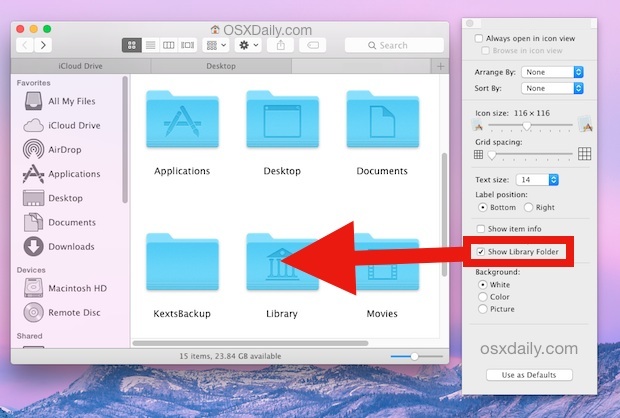
- To make it permanently visible enter the following in the Terminal application window: chflags nohidden /Library and press the Return key - 10.7: Un-hide the User Library folder. For Mavericks, Yosemite, El Capitan and Sierra go to your Home folder and use the View Show View Options menu to bring up this window.
Sep 27, 2016 Open Finder, or just click on the desktop. Then click “Go” in the menu bar, and select “Go to Folder”. You can also skip all this clicking by pressing Command+Shift+G on your keyboard to access the Go to Folder menu. Type /Library in the box and hit Enter. Apr 17, 2017 NOTE: In Lion, Mountain Lion, Mavericks, Yosemite, El Capitan and Sierra the Home/Library folder is now invisible.To make it permanently visible enter the following in the Terminal application window: chflags nohidden /Library and press the Return key - 10.7: Un-hide the User Library folder. For Mavericks, Yosemite, El Capitan and Sierra go to your Home folder and use the View Show View. Yosemite Library Where To Go & What Go Do Chapter 5. The High Sierra. Yosemite: Where To Go and What Go Do (1888) by George G. The High Sierra. This is the name commonly in use to designate those parts of the Sierra Nevada ranging above the Yosemite Valley to the north, east and south. Although bearing a.
** TeX on Yosemite **
TWGMacTeXDonateFAQFontsHelpReferencesSupportAcknowledgmentsTUG
Yosemite
MacTeX works fine on Apple's latest operating system, Yosemite. This page listsa few problems users encountered with TeX when updating to Yosemite. A new operatingsystem is expected in the fall of 2015; this page may be helpful for that update.X Windows and Quartz
Some folks use xdvi to display TeX Output on X Windows. There are reports that linksin X Windows are removed and the X11 display fails. The solution is to reinstall Quartz.To do so, go to http://xquartz.macosforge.org.Ghostscript
Go Library Mac Yosemite 2017
We have reports that Ghostscriptis broken, but actually it isn't. We ship two Ghostscript binaries, one with support for X11and one without this support. The binaries, in /usr/local/bin, are named gs-X11 and gs-noX11.The file gs in this location is a link to the approprite binary.If Apple removes X11 during an update, the binary gs-X11 will fail to run. There are twoeasy solutions. The first is to install X11 as above. The second is to reset the link gs to point to gs-noX11. Users who don't know the appropriate Unix commands should install X11, becausethat is the easiest fix.
Installing Yosemite
The biggest problem by far with Yosemite occurs during installation, and then only for userswho already have TeX. The installer begins by moving /usr/local to a temporary location. Then it installs the new system. Near the end, the installer moves the contents of /usr/local back totheir original location, but in the process it carefully examines each file. Since TeX containshundreds of thousands of files, this final step can last from an hour to over twelve hours. Users who let installation run all night report success in the end.Avoiding the Problem
Ross Moore sent an extremely useful method of avoiding the problem. He writes'A colleague tells me that the way to update to Yosemite, withone or more TeX installations installed, is to first
- mv /usr/local/texlive ~
- do the install, then
- mv ~/texlive /usr/local
'This avoids the installer archiving, and then re-installing thehierarchy *file-by-file*. This kind of approach may be useful with other subdirectoriesof /usr/local as well.'
This solution moves the texlive directory to the User's home directory, installs Yosemite,and then moves the texlive directory back to its proper location. In more detail, theappropriate commands are as follows (spaces in these commands are essential, so copyingthe commands may work better than retyping them):
- sudo mv /usr/local/texlive ~
- install Yosemite
- sudo mv ~/texlive /usr/local
The TeX Dist Preference Pane
The TeX Dist Pane we distributed with MacTeX-2014 does not work in Yosemite. A newerreplacement for Yosemite is available at http://download2.polytechnic.edu.na/pub4/sourceforge/m/ma/mactextoolbox/TeXDist/.
As you say, the standard way to rebuild an iTunes library has always been to load the iTunes Library.xml file, and iTunes would rebuild its database, which is stored in the iTunes Library.itl file. If you have no idea how to repair iTunes Library, you should try Android Transfer - TunesGo. This is an easy-to-use file manager for Mac/Win, able to transfer up-to-10 types of files between devices, phone and computer, along with free and handy tools like Rebuild iTunes Library, Phone to Phone Transfer. How to restore itunes library on mac. Jun 19, 2015 iMusic - Rebuild iTunes Library on Mac. Rebuild, Analyzes and cleans up your music library on Mac or Windows with one click. Transfer and manage your data on your Android Phone & Tablet. May 04, 2017 iTunes Library Step 1 Launch Wondershare TunesGo on your Mac, go to 'Applications' and search for Wondershare TunesGo and double-click on it to open. Step 2 Click 'Rebuild iTunes Library'. Once the iOS device is connected, click on 'Rebuild iTunes Library' on. How to Rebuild iTunes Library on Windows/Mac Computer. Shut down iTunes. Go to iTunes folder. The location of iTunes folder vary from computers. On windows 7/8/10, the location is, C:UsersYour Computer UsernameMy. In iTunes folder, click “Previous iTunes Libraries”, and copy the latest.
It is possible to recover the basic functions of the PreferencePane by using the command line. This was pointed out by BrunoVoisin. Open Terminal in /Applications/Utilities. To see a list ofcurrent TeX distributions:
- texdist --list
- texdist --current
- sudo texdist --setcurrent=TeXLive-2014
Mac Yosemite Version Number
CocoAspell
CocoAspell runs fine on Yosemite, but the installer runs into troubleinstalling dictionaries on a fresh copy of Yosemite, and the SpellingPref Pane installed by CocoAspell does not initially run. The author has been notified of the trouble.One possible solution is listed below, but Thaddeus Perala provided an easier fixwhich does not require retrieving files from an earlier system. To read about hissolution, click here.
In the release version of Yosemite, it is possible to resurrect cocoAspellas follows. From an installation of CocoAspell on Mavericks, go to/usr/local/lib and find a folder named aspell-0.60 and several libraries whose names start with libaspell or libpsell. Copy this folder and these libraries to Yosemite, and move them into /usr/local/lib, creating this folder if necessary. Using sudo, change the owner of the files to root.
Mac Yosemite Review
Again on Mavericks, go to '/Library/Application Support' and find thefolder named cocoAspell. Copy this folder to Yosemite and place it in '/Library/Application Support' there. Migration assistant mac os needs to repair your library.
Go Library Mac Yosemite 2017
After these steps, the cocoAspell Preference Pane will run and the spell checker can be used as usual.